
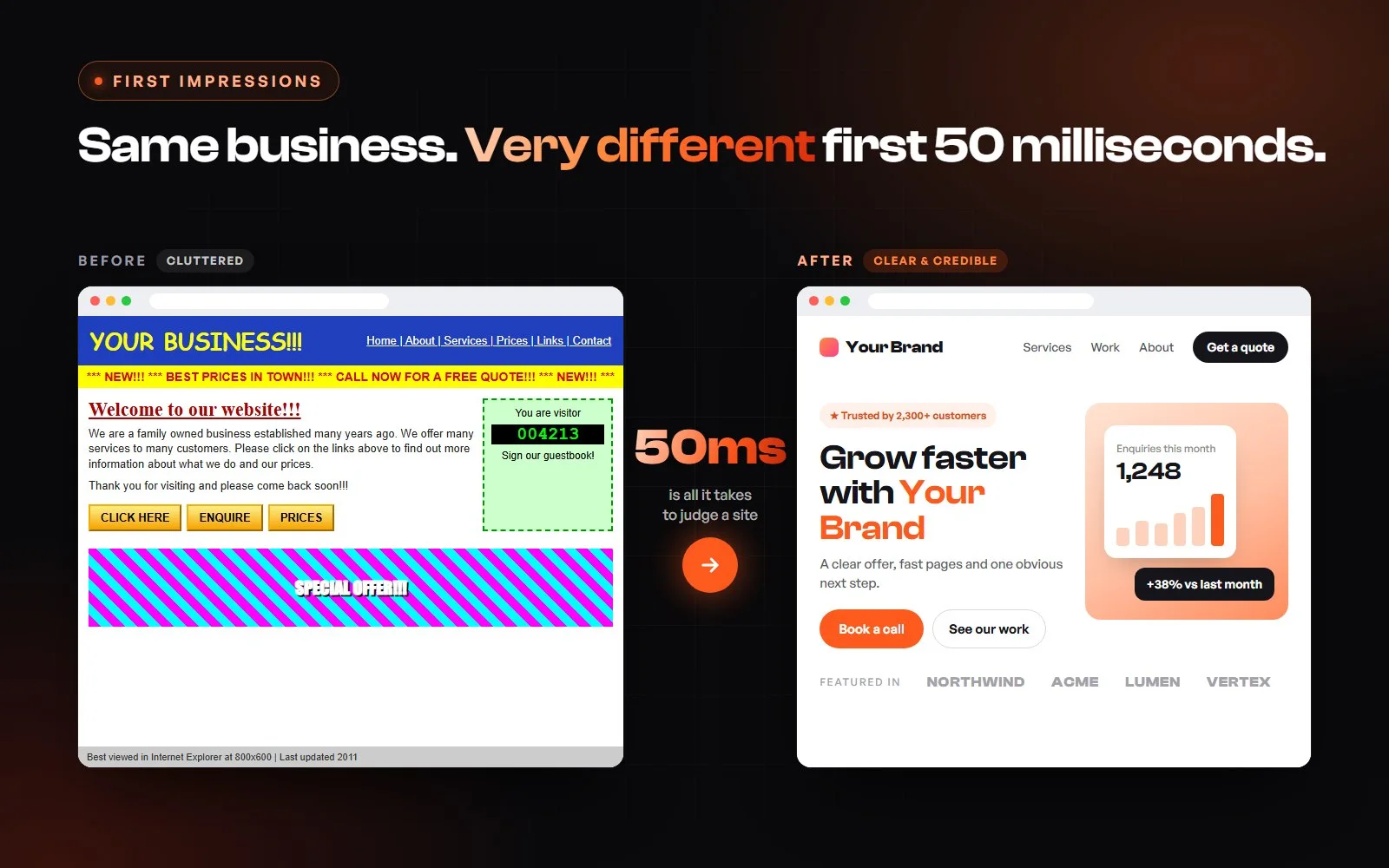
Your website is usually the first serious conversation a customer has with your business, and it happens without you in the room. Visitors form a first impression in about 50 milliseconds. In that blink they decide whether you look credible, whether you're for them, and whether it's worth scrolling.
A good website isn't just one that looks nice. It's one that loads fast, makes the offer obvious, works perfectly on a phone, gets found in search and guides people to one clear next step. This guide covers the principles, pages and process I use when designing and building websites for clients.
Good website design combines clarity, credibility and conversion. Lead with a clear offer, design mobile-first, keep pages fast and accessible, build trust with real proof, and give every page one obvious call to action. Plan for SEO and AI search from the start, not after launch.
What Is Website Design?
Website design is the planning and creation of how a website looks, feels and works. It covers much more than colours and fonts:
- Information architecture: which pages exist, how they're grouped and how people move between them.
- User experience (UX): how easy it is for a visitor to find what they need and take action.
- User interface (UI): the visual layer, including layout, typography, colour, imagery and components.
- Content design: headlines, copy and calls to action that explain the offer clearly.
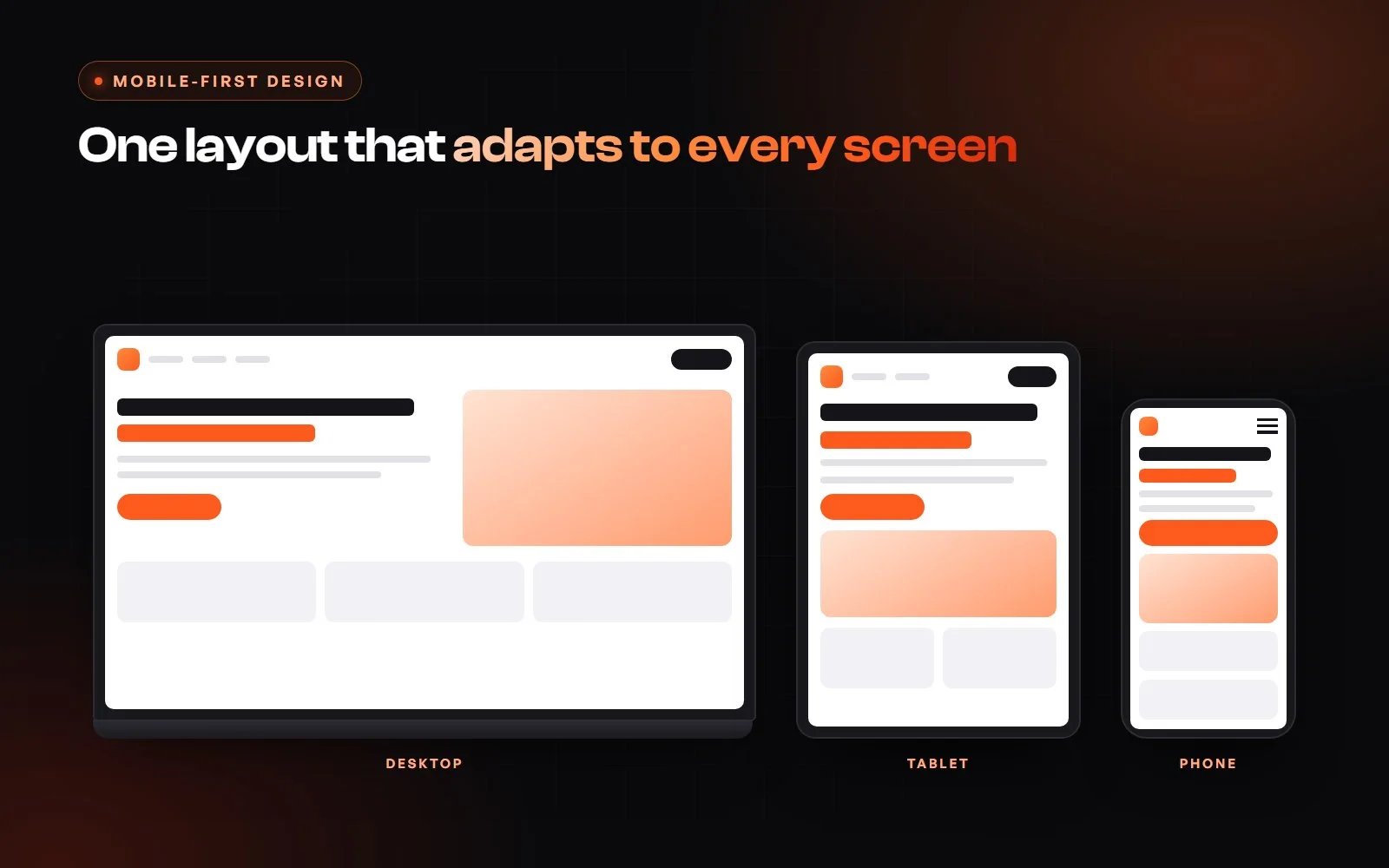
- Responsive design: making every page work just as well on phones, tablets and desktops.
Why Website Design Matters
Most buying journeys pass through your website, even when they start on social media, Google or an AI assistant. Good design affects almost every number that matters:
- Trust: an outdated or cluttered site makes even a great business look risky.
- Conversions: clear layouts and obvious calls to action turn more visitors into enquiries and sales.
- Search visibility: speed, structure and mobile experience all influence how well you rank.
- Marketing efficiency: every ad, post and email performs better when it lands on a page that converts.
For a fertility clinic, a homepage redesign meant balancing clinical credibility with warmth. For a construction company, it meant putting industry credentials front and centre. The principles are the same; what changes is what your specific buyers need to see first.
Website Design vs Website Development
The two are closely linked but they're different jobs. Design decides what the site should be; development makes it real.
| Website design | Website development | |
|---|---|---|
| Focus | Structure, user experience, visuals and content layout. | Code, functionality, performance and integrations. |
| Tools | Figma, wireframes, design systems and prototypes. | HTML, CSS, JavaScript, WordPress, WooCommerce and Shopify. |
| Output | Approved page designs ready for handoff. | A live, fast, working website. |
| Answers | "What should this page say and how should it feel?" | "How do we make it work, load fast and stay secure?" |
When the same person or team handles both, fewer ideas get lost in translation between the design file and the finished site.
The Principles Of Good Website Design
1. Clarity Beats Cleverness
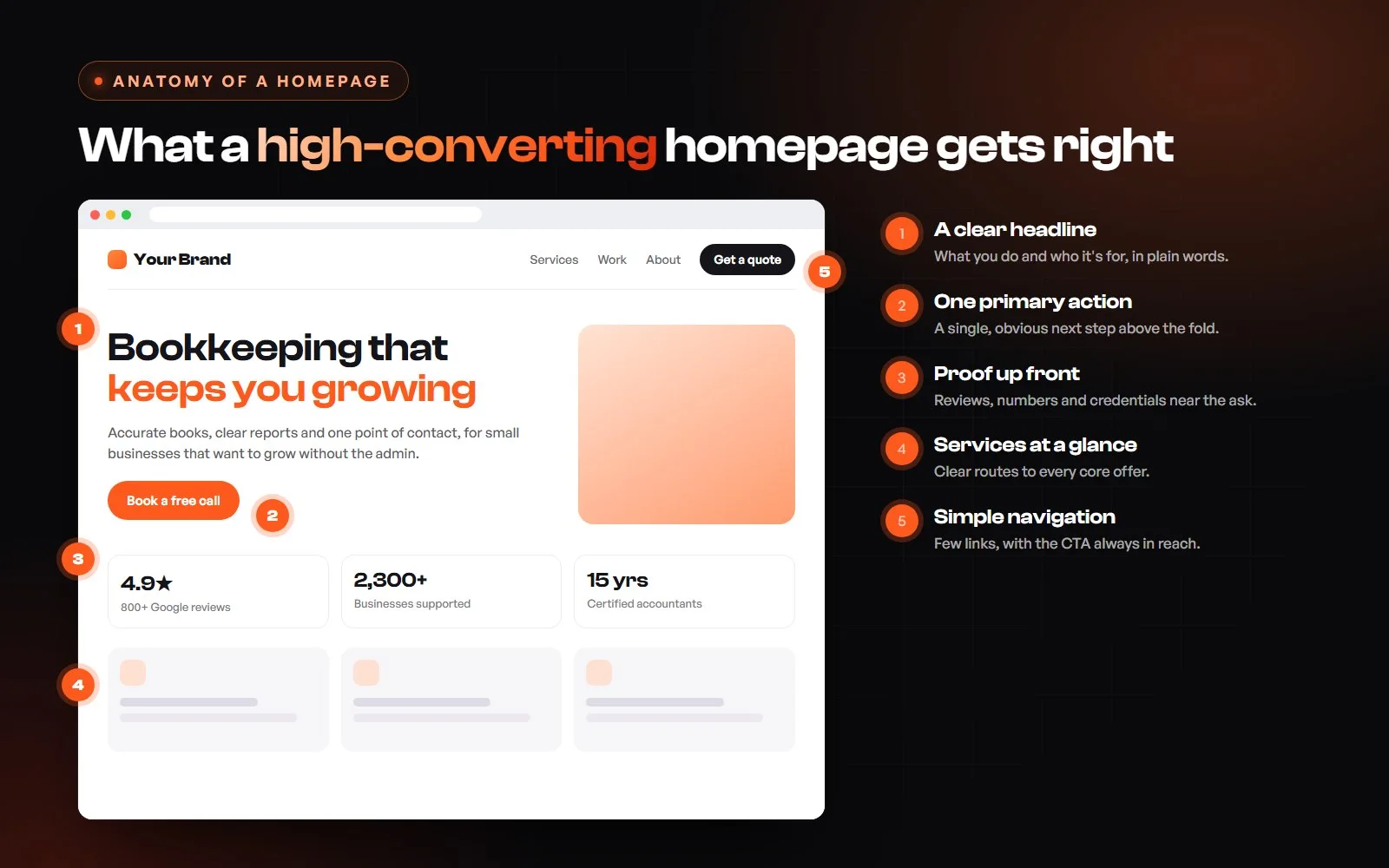
Within seconds, visitors should know what you do, who it's for and what to do next. Use a plain-language headline over a clever slogan, and one primary call to action per page.
2. Design Mobile-First
Most visitors arrive on a phone. Design for the small screen first, with tap-friendly buttons, readable text and no sideways scrolling, then expand the layout for larger screens.
3. Use Visual Hierarchy
Size, colour, contrast and spacing should guide the eye to what matters most. If everything is bold, nothing stands out. White space isn't wasted space; it's what makes the important parts easy to see.
4. Make It Fast
Slow pages lose visitors and rankings. Compress images, serve modern formats, limit heavy scripts and plugins, and keep an eye on Core Web Vitals.
5. Build Trust Everywhere
Real photos, client logos, reviews, case studies, credentials and clear contact details reassure visitors that you're legitimate. Put proof close to the moment you ask for action.
6. Design For Everyone
Accessible design, with strong colour contrast, descriptive alt text, keyboard navigation and readable font sizes, makes your site usable for more people and is easier for search engines to understand.
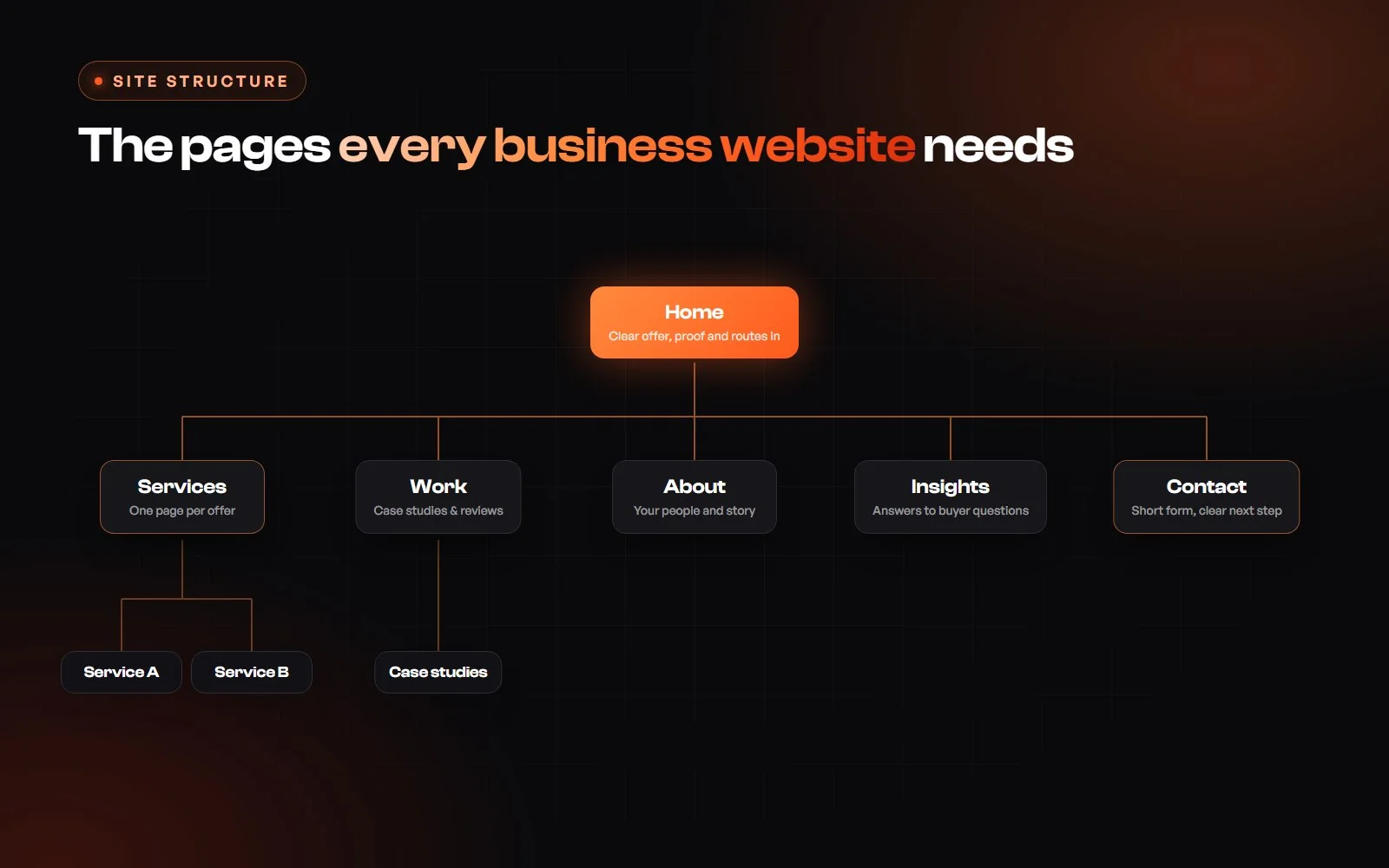
The Pages Every Business Website Needs
- Homepage: a clear offer, proof and routes to your key services.
- Service or product pages: one page per core offer, each answering what it is, who it's for, what it costs or how it works, and how to start.
- About page: the people and story behind the business, which is often the second most-visited page.
- Proof: case studies, portfolio, testimonials or reviews.
- Contact page: a short form, phone, email, location and what happens after someone gets in touch.
- Blog or resources: helpful content that answers customer questions and earns search visibility.
Specialist businesses need specialist flows. For EcoZen, an exporter, that meant an enquiry-to-quotation process instead of a standard checkout. For Love Nature Wellbeing, it meant combining a WooCommerce store with a space for therapists to offer their services.
The Website Design Process: Step By Step
- Discovery: understand the business, audience, competitors and goals.
- Sitemap and structure: plan the pages and how people will move through them.
- Wireframes: map the layout and content of key pages before any visual design.
- Visual design: design the pages in Figma with the brand's typography, colours and imagery.
- Development: build the site on the right platform, responsive and optimised for speed.
- Testing and launch: check every device, browser, form and link, then set up analytics and tracking.
- Improve: review real visitor data and keep refining after launch.
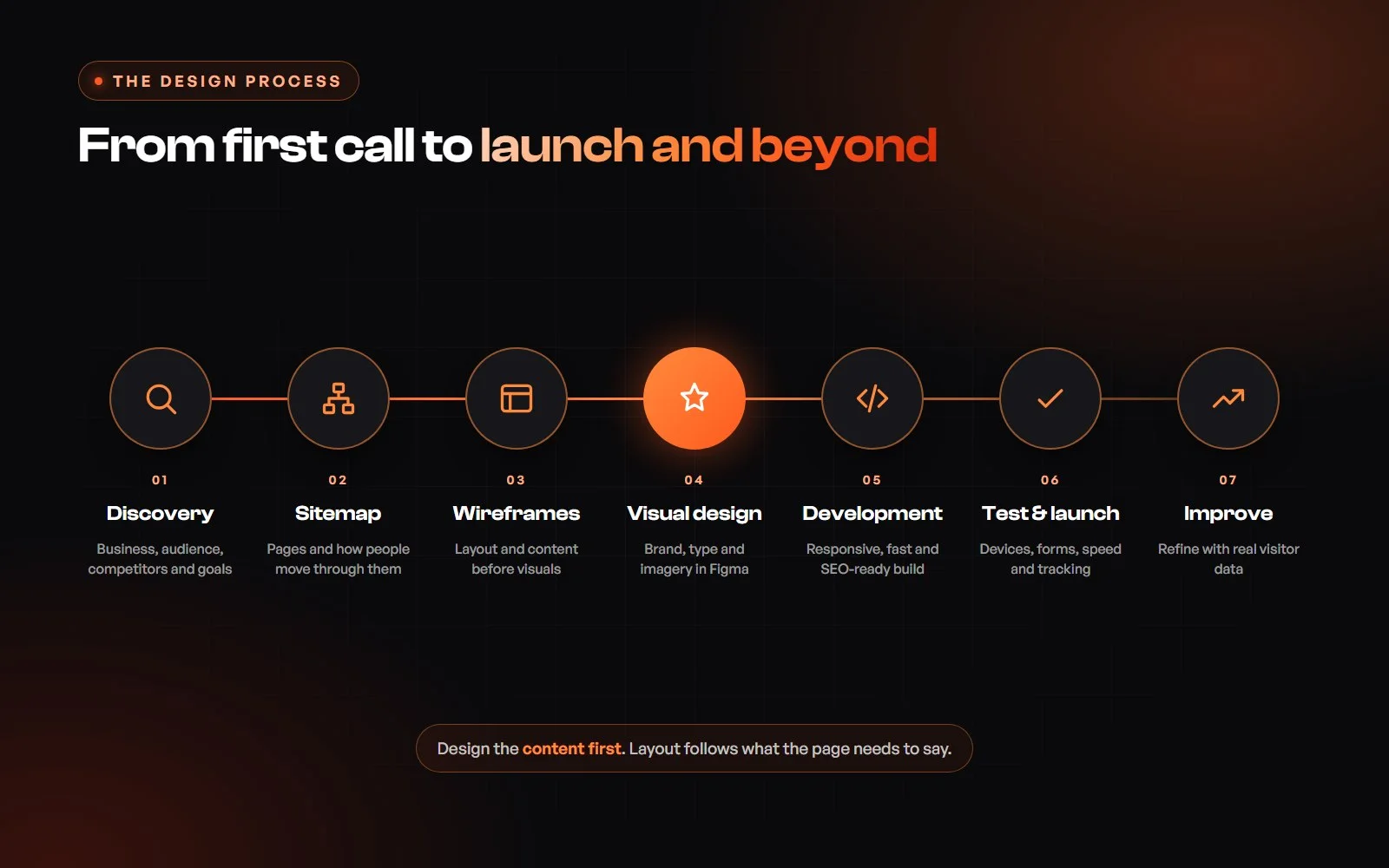
Design the content first. A beautiful layout can't save a page that doesn't clearly explain what you offer.
How To Design A Website For Search And AI
A website that looks great but can't be found won't grow your business. Build search into the design from day one:
- Plan pages around what customers actually search for, with one clear topic per page.
- Use a single H1 and logical H2 and H3 headings so search engines and AI assistants can understand and quote your content.
- Keep important pages within a few clicks of the homepage, linked with descriptive anchor text.
- Add structured data for your business, services, articles and FAQs.
- Answer common questions directly on the page. AI tools like ChatGPT and Gemini favour clear, specific, well-structured answers.
Retrofitting SEO after launch is always harder and more expensive than designing for it from the start.
How To Measure Website Success
A website is a business tool, so measure it like one:
- Conversion rate: the share of visitors who enquire, book, sign up or buy.
- Engagement: time on page, scroll depth and which pages people visit before converting.
- Speed and Core Web Vitals: how quickly and smoothly pages load on real devices.
- Organic visibility: impressions, rankings and clicks from Google Search Console.
GA4 and Search Console cover the essentials for free, and heatmap tools show exactly where visitors click, scroll and drop off. Use what you learn to keep improving. The best websites are never really finished.
Great website design isn't about following trends. It's about understanding your customers, making your offer impossible to misunderstand and removing every bit of friction between interest and action.