
Ask ten people what SEO is and most will say "ranking on Google". That was a fair answer a few years ago. Today it's only part of the picture. Your buyers search on Google, but they also ask ChatGPT, Gemini and Perplexity, read Google's AI Overviews, and scroll YouTube, Reddit and TikTok for answers.
Modern SEO is about visibility: showing up wherever people look for what you offer, and being the brand that search engines and AI assistants trust enough to recommend. This guide covers what that means in practice, how search actually works, and the core practices I use with clients to grow organic visibility.
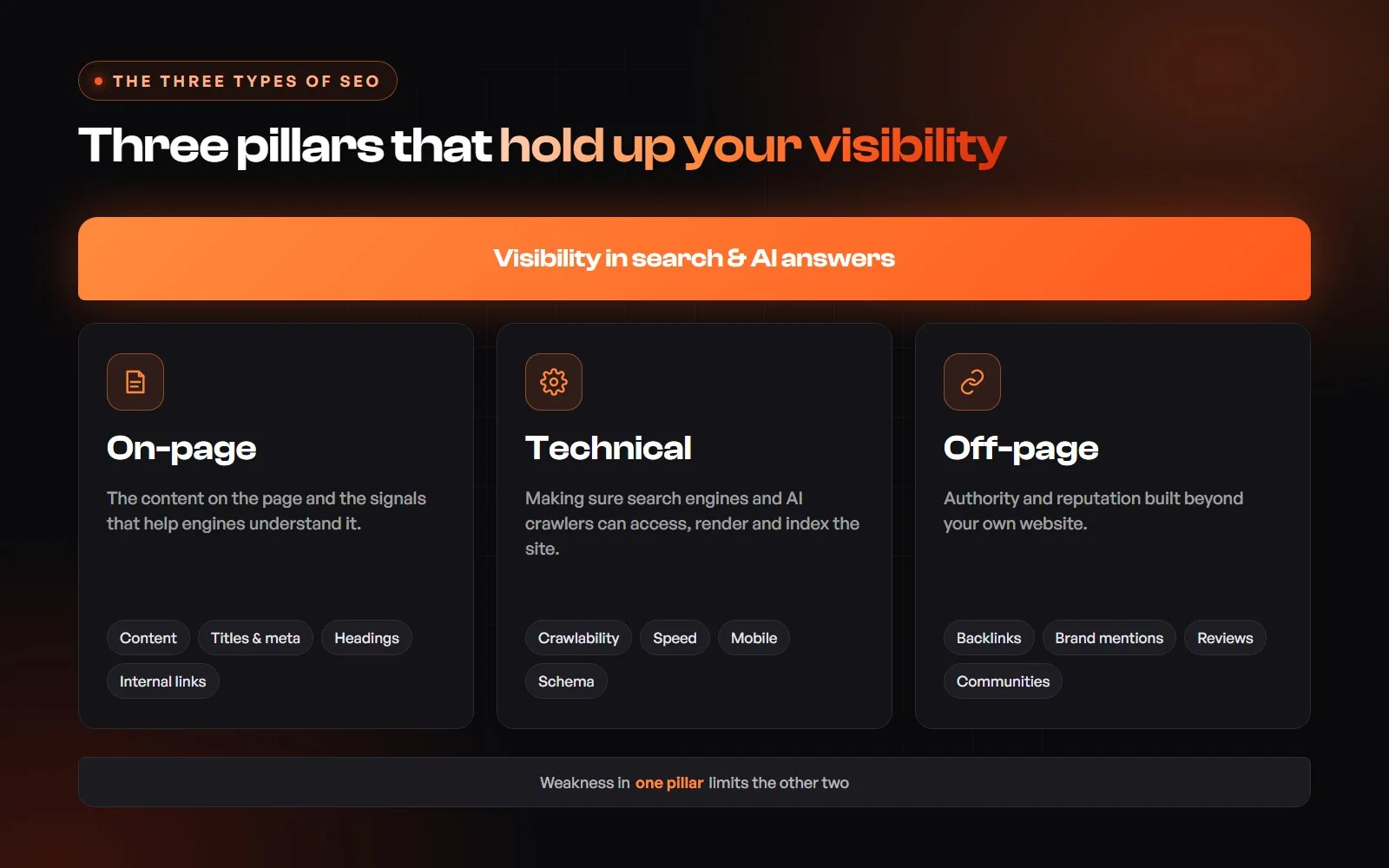
SEO is the practice of earning unpaid visibility in search engines and AI answers. It rests on three pillars, on-page, technical and off-page, and it compounds over time. Rankings still matter, but the real goal is being found, cited and chosen wherever your buyers search.
What Is SEO?
SEO (search engine optimization) is the process of improving your website and your wider online presence so that you earn more organic, unpaid visibility in search results. That includes classic blue links on Google and Bing, rich results like featured snippets and map packs, and, increasingly, mentions and citations inside AI-generated answers.
Search systems all try to answer the same question: which result best satisfies this person's need? They judge that on three broad things:
- Relevance: does the page actually answer what was asked, in the format the searcher wants?
- Authority and trust: do other credible sources reference you, and does the content show real experience and expertise?
- Accessibility: can search engines and AI crawlers find, render and understand the page in the first place?
Optimising for AI answer engines is often called GEO (generative engine optimization) or AEO (answer engine optimization). In practice it isn't a separate discipline. It's SEO done well, with extra attention to clear structure, quotable facts and brand mentions across the web.
Why SEO Still Matters
Every year someone declares SEO dead, and every year organic search remains one of the largest and highest-converting traffic sources for most businesses. AI assistants haven't replaced search. They've added another place where people search, and those assistants pull heavily from the same pages that already rank well.
- It captures demand that already exists. People searching for your product or problem are already looking to buy or learn. You're not interrupting them.
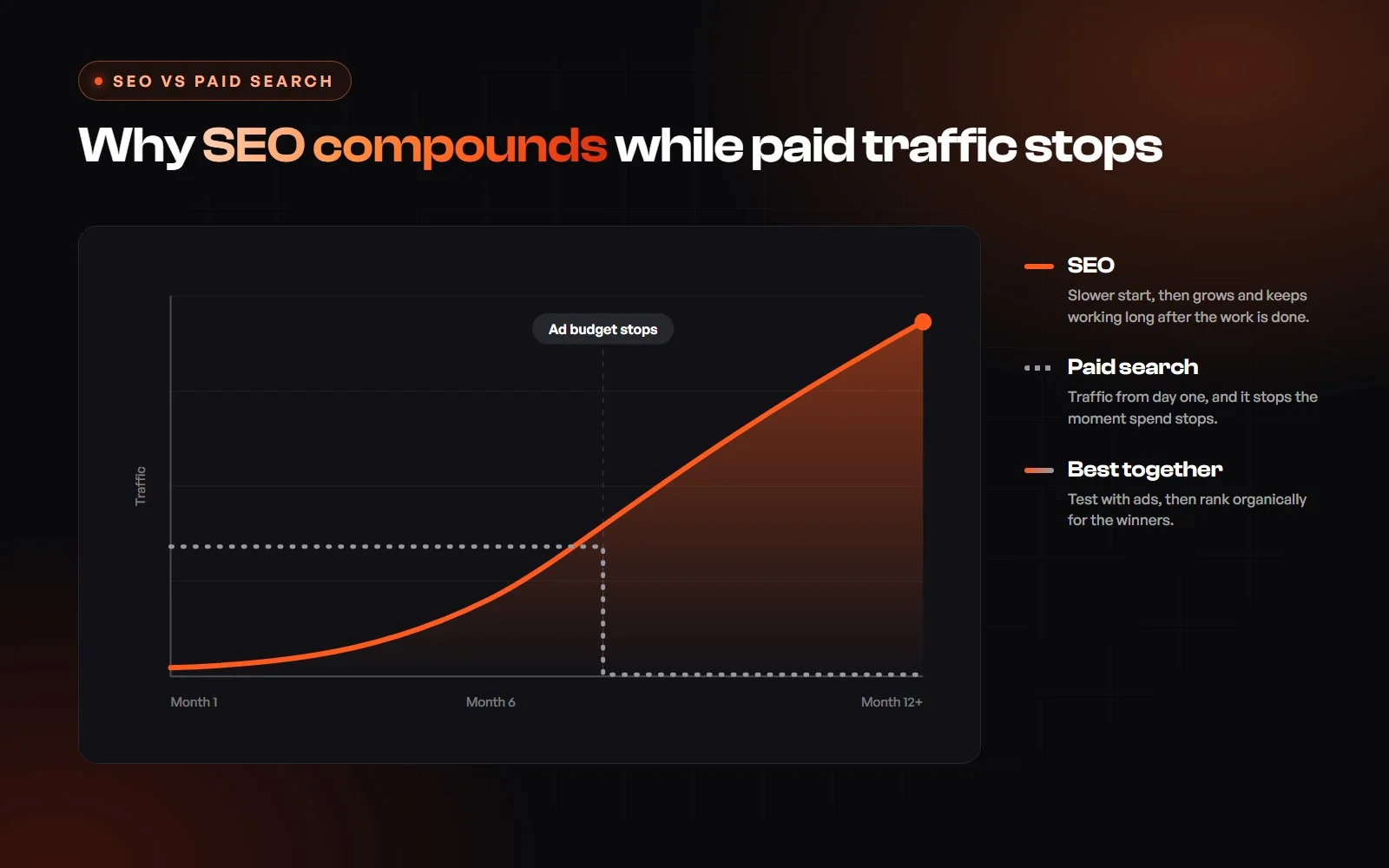
- It compounds. A well-built page can bring in traffic for years. Paid traffic stops the moment the budget does.
- It builds trust. Many searchers skip ads and trust organic results and AI recommendations more.
- It feeds AI visibility. AI assistants retrieve and cite web content. If you're invisible in search, you're usually invisible in AI answers too.
In my own work, growing a lab-supplies catalogue's daily impressions from 2K to 17K+ came from these fundamentals, not tricks: a cleaner architecture, better pages and content matched to what buyers actually search.
How Is SEO Different From Paid Search?
Paid search (PPC) means paying for ad placements, usually per click. SEO means earning placement for free. Both target the same searchers, and the strongest strategies use them together.
| SEO | Paid search | |
|---|---|---|
| Cost | No cost per click; you invest in content, technical work and expertise. | You pay for every click, and costs rise with competition. |
| Speed | Usually three to six months before meaningful movement. | Traffic from the day campaigns go live. |
| Longevity | Results compound and persist after the work is done. | Traffic stops when spend stops. |
| Trust | Organic results and AI citations carry more credibility. | Clearly labelled as ads, and some users skip them. |
| Best for | Long-term growth, authority and lower acquisition cost over time. | Launches, promotions, testing offers and filling gaps fast. |
A practical pattern: use paid search to test which keywords and offers convert, then invest SEO effort in ranking organically for the winners.
The Three Types Of SEO
SEO work falls into three areas. Each one matters, and weakness in one usually limits the other two.
1. On-Page SEO
On-page SEO is everything you control on the page itself: the content, and the signals that help search engines understand it.
- Content that fully answers the query, written for people first
- A clear title tag and meta description that earn the click
- Logical headings (H1, H2, H3) that make the page easy to scan and to summarise
- Descriptive URLs, image alt text and internal links to related pages
- Natural use of the terms and questions your audience actually uses
2. Technical SEO
Technical SEO makes sure search engines and AI crawlers can access, render and index your site efficiently. It's the foundation everything else stands on.
- Crawlability and indexation: robots.txt, XML sitemaps, canonical tags
- Site speed and Core Web Vitals
- Mobile-friendly, responsive design
- Clean site architecture, with important pages a few clicks from the homepage
- Structured data (schema) so engines understand products, articles, FAQs and organisations
- Hreflang and localisation for sites serving multiple countries
On large sites this is where the biggest wins hide. On a 64,000+ product catalogue, fixing crawl waste and duplicate pages can unlock more growth than writing new content.
3. Off-Page SEO
Off-page SEO is about building authority and reputation beyond your own site.
- Backlinks from relevant, trusted websites
- Brand mentions in news, industry publications and reviews, even without a link
- Presence in the communities AI tools often cite, like Reddit, forums, review sites and YouTube
- A complete, active Google Business Profile for local businesses
How Do Search Systems Work?
How Search Engines Work
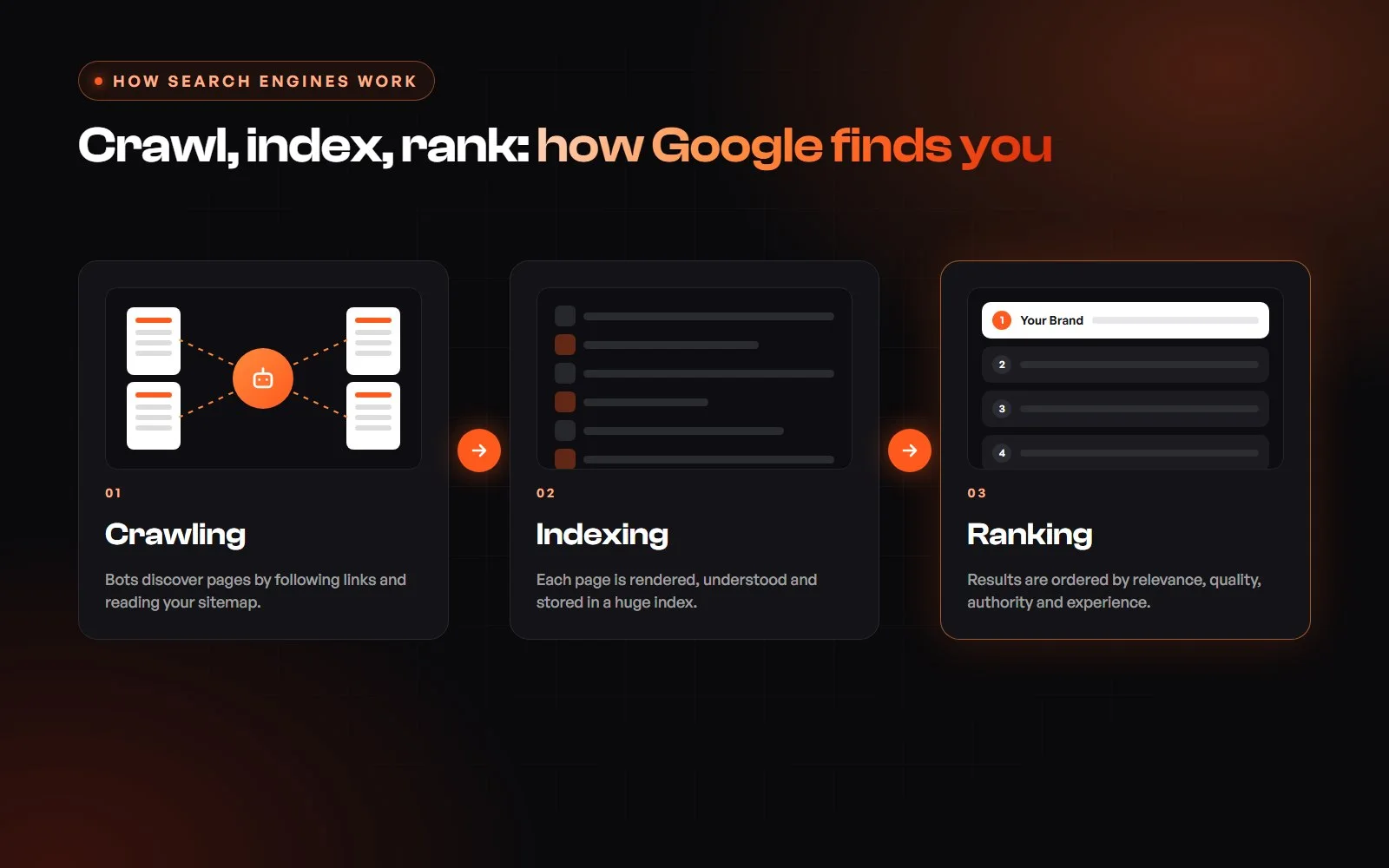
Traditional search engines like Google work in three stages:
- Crawling: bots discover pages by following links and reading sitemaps.
- Indexing: the engine renders and analyses each page, then stores it in a huge index.
- Ranking: when someone searches, the engine pulls matching pages from the index and orders them by hundreds of signals, including relevance, quality, authority, freshness, location and page experience.
Results also appear in different formats, called SERP features: featured snippets, "People also ask", image and video packs, local map packs, shopping results and AI Overviews. Each is a separate opportunity to be seen.
How AI Search Works
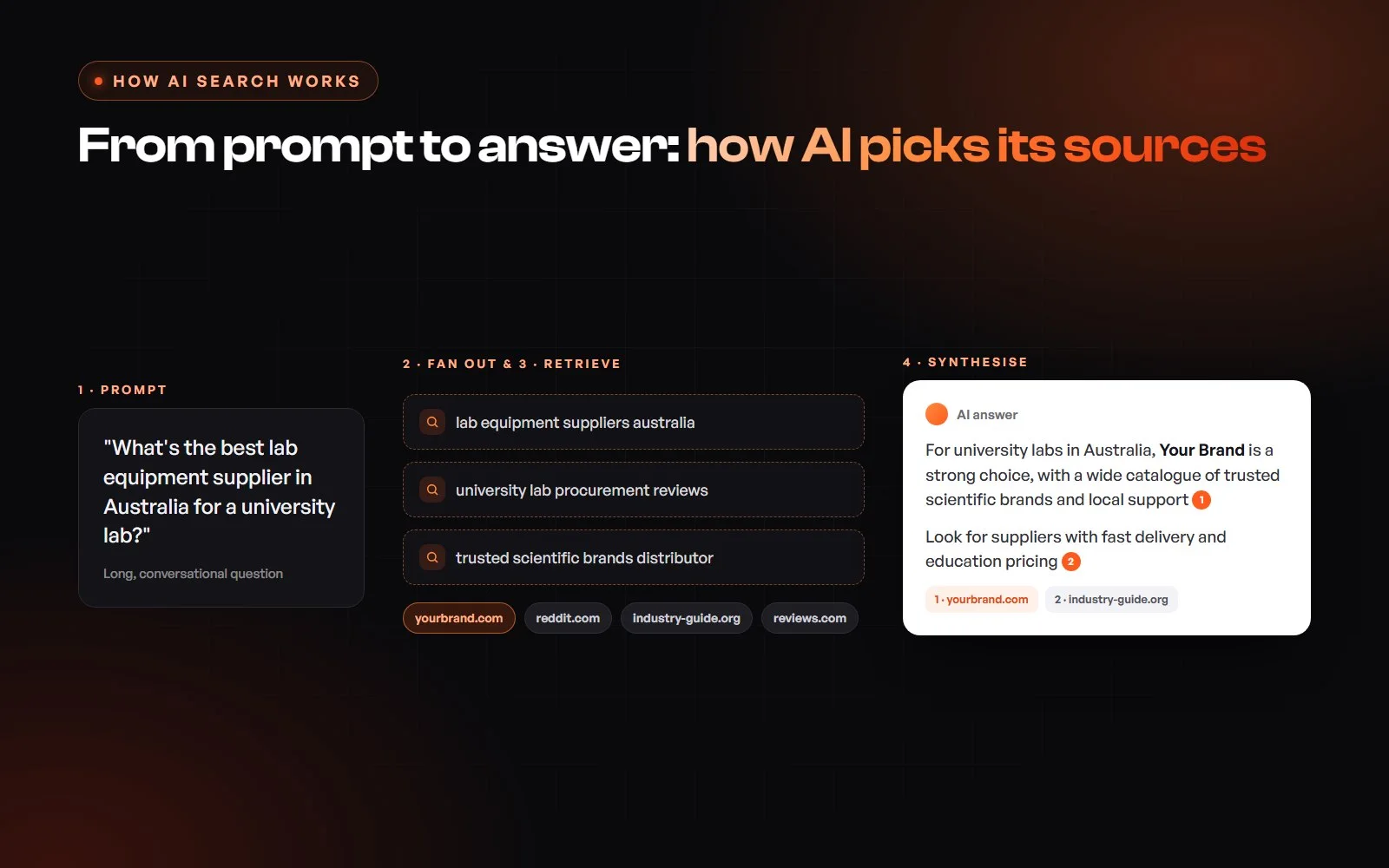
AI assistants such as ChatGPT search, Gemini, Perplexity and Google's AI Overviews follow a slightly different path:
- Interpret the prompt: work out what the person really wants, often from a long, conversational question.
- Fan out: break it into several related sub-searches behind the scenes.
- Retrieve: pull passages from web pages that match those sub-searches by meaning, not just keywords.
- Synthesise: write one answer, often citing or linking the sources it relied on.
AI answers are built from passages. Pages with clear headings, direct answers and specific facts are far easier for an assistant to quote.
That's why GEO rewards the same things good SEO does: well-structured pages, original information, and a brand that's mentioned positively across trusted sources.
How To Get Started With SEO: 5 Core Practices
1. Research Keywords And Prompts
Find the words and questions your audience actually uses. Tools like Semrush, Ahrefs and Google Search Console show search volume, difficulty and the queries you already appear for. Go beyond keywords too: list the longer, conversational prompts buyers might type into an AI assistant, and check whether your brand shows up in the answers.
2. Create Content That Deserves To Rank
Look at what already ranks to understand search intent. Is the searcher after a guide, a comparison, a product page or a local service? Match the format, then do it better. Google's E-E-A-T principles (experience, expertise, authoritativeness, trust) are a useful lens: first-hand insight, original data and real examples are what set content apart, and they're exactly what AI tools like to cite.
3. Optimise On-Page Elements
Write a unique title tag and meta description for every important page, use one clear H1, structure the rest with descriptive subheadings, keep URLs short and readable, add alt text to images, and link related pages together. Then run a site audit to catch what you missed.
4. Keep Your Site Technically Healthy
Run a regular technical audit with a crawler like Screaming Frog or Semrush Site Audit. Fix errors first (broken pages, blocked resources, indexation problems), then warnings, then minor notices. Watch Core Web Vitals and the indexing reports in Search Console so small problems don't quietly grow.
5. Earn Links And Brand Mentions
Create things worth referencing, like original research, useful tools and expert commentary, and get them in front of the right people. Pursue relevant, credible links over sheer volume, and turn unlinked brand mentions into links where you can. Mentions on trusted sites help both rankings and how AI assistants describe you.
How To Measure SEO Success
Track a small set of metrics that tie back to business results, not vanity numbers:
- Impressions and rankings: how visible you are for the terms that matter.
- Organic traffic and click-through rate: whether that visibility turns into visits.
- Conversions and revenue: leads, sales and enquiries from organic search, the number that actually matters.
- AI visibility: how often AI assistants mention or cite your brand for key prompts, where you appear in the answer, and the sentiment of how you're described.
Google Search Console and GA4 cover the core metrics for free. Dedicated AI visibility tools, or regular manual checks of your key prompts, cover the rest. Review monthly, but judge strategy over quarters. SEO is a compounding game.
How To Learn SEO In 2026
The fastest way to learn SEO is to combine structured learning with hands-on practice:
- Work through Google's own Search Central documentation and free courses from tools like Semrush Academy and Ahrefs.
- Build or take over a small site and apply what you learn. Nothing teaches faster than watching your own pages move.
- Set up Search Console and GA4 so you can see cause and effect.
- Track a handful of prompts in ChatGPT, Gemini and Perplexity to understand how AI answers are changing.
Search keeps evolving, but the fundamentals hold: make pages that genuinely help people, make them easy for machines to understand, and build a reputation others want to reference. Do that consistently and visibility follows, on Google and in AI answers alike.